10 Low-Maintenance Perennials That Come Back Every Year
There's a particular satisfaction in the spring ritual of perennials returning. You did the work once — amended the soil, planted carefully, watered through establishment — and now, year after year, they come back on their own. That's the promise of perennials, and for the ones on this list, it's a promise they consistently keep.
Not every perennial earns the "low-maintenance" label, though. Some need annual division to stay vigorous. Others are magnets for disease or flop dramatically without staking. A few are technically perennial but behave like short-lived annuals outside a narrow hardiness band. This list skips all of that. These are plants that, once established in appropriate conditions, require little more than seasonal tidying and an occasional division every few years.
Zone references below use the post-2023 USDA Plant Hardiness Zone Map, which shifted many areas half a zone warmer compared to the previous version.
1. Purple Coneflower (Echinacea purpurea)
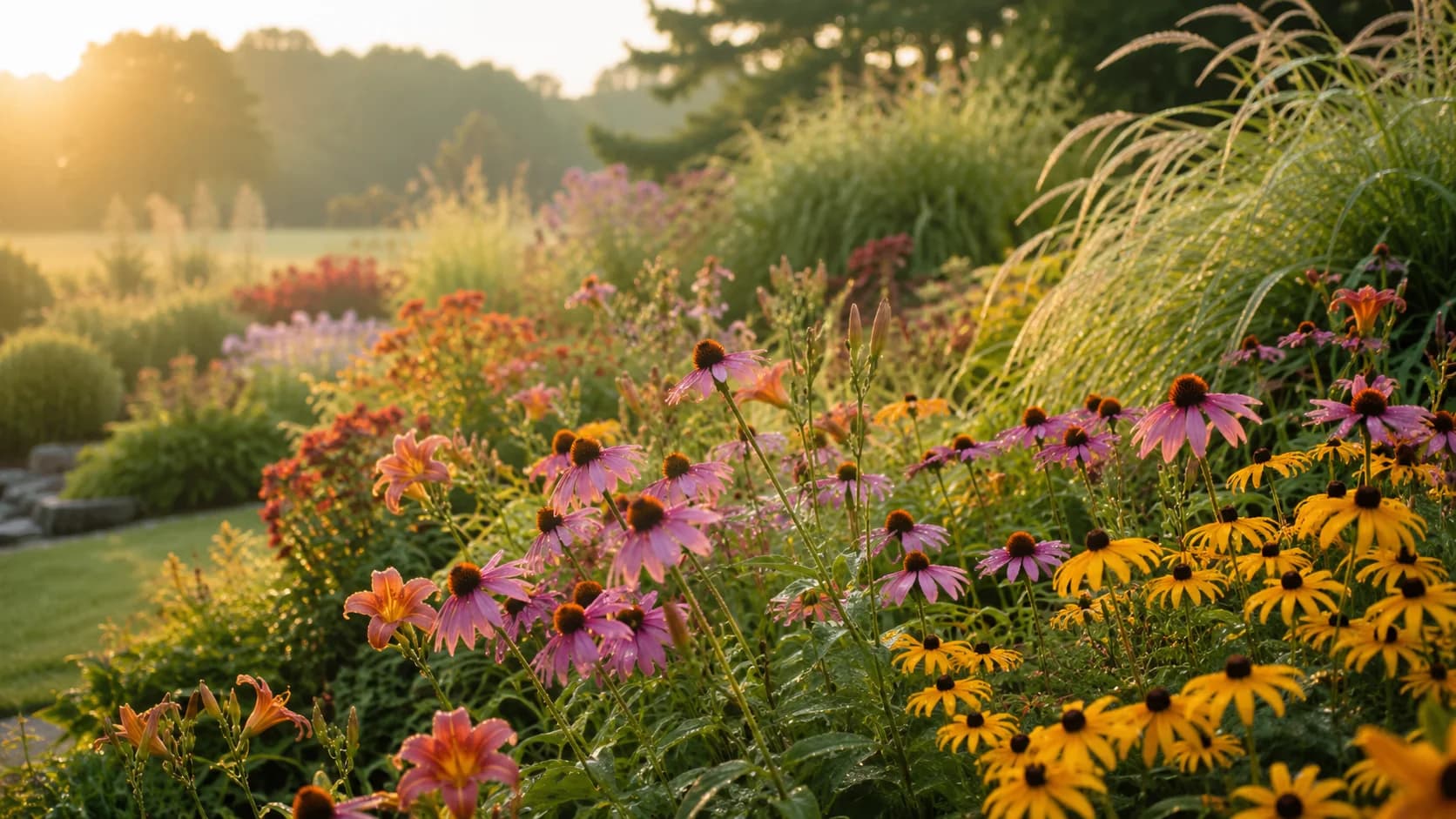
Coneflower is the workhorse of the low-maintenance perennial border. Native to eastern North America, it's hardy in zones 3–9 and handles heat, drought, and indifferent soil with genuine grace. The classic species produces rosy-purple petals around a bronze center cone, but cultivars like 'Magnus' (larger flowers on sturdy stems, Perennial Plant of the Year 1998) and 'White Swan' (clean creamy-white, beautiful with ornamental grasses) offer easy variation without demanding anything different from you.
Leave the seed heads standing through winter — goldfinches will pick them clean over the cold months. Divide every 4–5 years to keep plants vigorous.
2. Black-Eyed Susan (Rudbeckia fulgida 'Goldsturm')
'Goldsturm' may be the most reliable garden perennial in the United States. Golden-yellow daisy flowers with dark centers, sturdy 24-inch stems, and a tendency to spread gradually into a satisfying mass over years. Hardy to zone 3, it tolerates heat and humidity better than many Rudbeckia species and is largely pest- and disease-free.
Full sun to light shade, average soil, average water. Deadhead if you want extended flowering or let seed heads stand for winter interest — birds appreciate both options. Divide every 4–5 years when the center starts to thin out.
3. Russian Sage (Salvia yangii, formerly Perovskia atriplicifolia)
Nothing quite captures the hazy, silver-blue look of midsummer like Russian sage in full bloom. Fine-textured silver stems and lavender-blue flower spikes work beautifully as a backdrop for bolder perennials — roses, coneflowers, ornamental grasses. Hardy in zones 4–9, drought-tolerant once established, and reliably deer-resistant.
'Little Spire' is a compact cultivar (18–24 inches) that stays tidy without staking — particularly useful if you've found standard Russian sage flopping in rich soils. Cut it hard to the ground in late winter before growth emerges; it blooms on new wood and benefits from the hard reset.
4. Daylily (Hemerocallis)
The phrase "blooms for one day" sounds like a flaw until you have a mature clump producing 30 buds at once. Daylilies are nearly indestructible: deep-rooted, drought-tolerant, adaptable to zones 3–9, and available in enough colors and forms to fill a lifetime of collecting. They tolerate clay, tolerate drought, and spread slowly into satisfying clumps over time.
For reliable low-maintenance performance, stick with proven diploid varieties: 'Stella de Oro' (compact, reblooms reliably all season — deservingly the best-selling perennial in the US for years), 'Happy Returns' (pale yellow, very long bloom period, similar habit to Stella but softer color), and 'Hyperion' (classic lemon yellow, exceptional fragrance, taller at 40 inches). Divide every 5–7 years when the center starts dying out.
5. Catmint (Nepeta x faassenii 'Walker's Low')
'Walker's Low' is not low-growing — the name refers to a garden in Northern Ireland where it was selected — but it is exceptionally easy. Lavender-blue flower spikes from May through June, handsome silver-gray foliage all season, and reliable rebloom after midsummer if you shear it back by half after the first flush. Hardy to zone 3, drought-tolerant, deer-resistant, and genuinely beloved by bees and other pollinators.
Plant it at the front or middle of a border where the soft mounding habit can spill gracefully over an edge or path. It pairs especially well with roses, coneflowers, and the upright forms of ornamental grasses.
6. Threadleaf Coreopsis (Coreopsis verticillata)
Coreopsis verticillata produces a cloud of fine-textured foliage and cheerful flowers from early summer through fall with almost no attention from you. 'Moonbeam' (soft pale yellow, Perennial Plant of the Year 1992) and 'Zagreb' (bright gold, more compact at 12–18 inches) are both excellent performers in zones 3–9. Heat-tolerant, drought-tolerant once established, and largely indifferent to poor soils.
Shear plants back by half in midsummer if flowering slows — they rebound with a fresh flush within a few weeks. Divide every 3–4 years to keep centers full and plants tidy.
7. Sedum 'Autumn Joy' (Hylotelephium 'Herbstfreude')
The last thing blooming in many late-season gardens is often 'Autumn Joy' sedum — dusty pink flowers that emerge in August, deepen to brick red through September, and age to russet-bronze as frost arrives. It's also a structural plant through the earlier seasons: thick, succulent blue-green foliage provides good texture from spring through late summer when most attention goes to showier things.
Hardy in zones 3–9, drought-tolerant, and genuinely pest-free. Leave the seed heads standing through winter — they hold their form well, catch snow elegantly, and provide a reason to look at the garden even in January. Divide every 3–5 years to prevent the center of the clump from opening up.
8. May Night Salvia (Salvia x sylvestris 'Mainacht')
'May Night' (sold under both the English translation and the original German name 'Mainacht') is among the best border salvias in cultivation. Deep violet-indigo flower spikes in late spring and early summer, reliable rebloom after cutting back, and solid hardiness to zone 4. It's deer-resistant, drought-tolerant once established, and works well at the front or middle of a mixed border where the rich color grounds other plants.
One requirement that matters: full sun and well-drained soil. 'May Night' will rot in wet winter conditions in heavy clay. If your soil drains slowly, amend it well before planting or establish this one in a raised bed.
9. Hosta
No honest list of low-maintenance perennials leaves out hostas — not because they're exciting, but because they do the job reliably where almost nothing else will. Deep shade, dry shade, tree root competition, neglect: hostas handle conditions that eliminate most other perennials. Hardy in zones 3–8, with some varieties performing in zone 9 in the West with afternoon shade.
For reliable performance, 'Sum and Substance' (giant, chartreuse-gold, striking as a specimen), 'Halcyon' (blue-gray foliage, notably slug-resistant, classic and widely available), and 'Patriot' (crisp white margins on dark green, very tidy in the landscape) are all deservingly popular. Slugs are the main problem in humid climates — scatter diatomaceous earth or use copper tape around new plantings until plants are large enough to absorb minor feeding damage.
10. Feather Reed Grass (Calamagrostis x acutiflora 'Karl Foerster')
'Karl Foerster' may be the single most useful ornamental grass in American horticulture. A neat, upright clump — no sprawling, no aggressive spreading — with feathery plumes that emerge in June and stand in good form through December. Perennial Plant of the Year 2001. Hardy to zone 4, tolerant of heat and humidity, and unfazed by the variable conditions (wet springs, dry summers, heavy clay) that challenge most ornamental plants.
Use it as a vertical accent behind lower perennials, as a mass planting along a fence line, or as a structural anchor for a mixed border that needs height. Cut it hard to the ground in late winter before new growth emerges — one annual cut is essentially all the maintenance it requires.
The Investment That Pays Off Every Year
The single most important thing you can do for new perennial plantings is water consistently through the first full season. Establishment is when perennials are most vulnerable, and most "failed" perennials actually died in their first summer — not from any long-term flaw in the plant, but because roots weren't established enough to handle a heat wave or a dry week. Once rooted in, most of the plants on this list will largely care for themselves.
For a customized planting schedule that tells you exactly when to plant, divide, and cut back perennials for your specific location, the free 12-month planting calendar at greenprint.garden is worth bookmarking. Enter your zip code and get a month-by-month guide built around your zone and local frost dates.