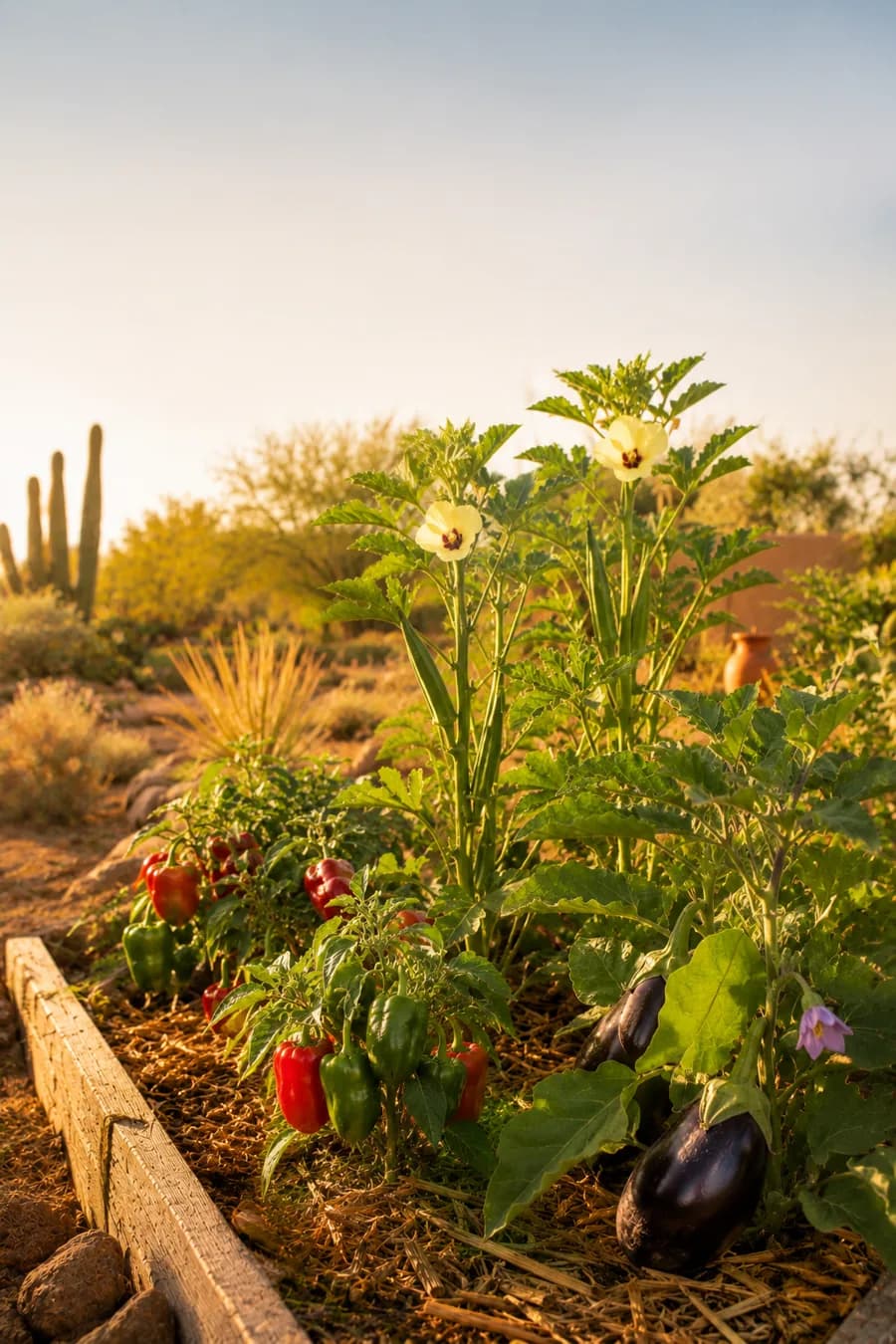
7 Drought-Tolerant Vegetables That Actually Produce
There's a category of gardening list every summer claims to solve drought: "10 vegetables for dry climates!" Click through and you find amaranth, malabar spinach, purslane, and four other crops you'd never actually want to eat in volume. Survival isn't the same as production.
This list is different. Every plant on it both survives on infrequent watering and produces a real harvest — pounds of food, not a teaspoon of edible leaves. If you garden in a climate with water restrictions, drought rules, or just an honest desire to skip the daily watering routine, start here.
Two caveats worth flagging up front:
- "Drought-tolerant" means established plants tolerate drought. Seedlings and transplants in their first 3-4 weeks still need consistent water to set roots. After that, you can pull back hard.
- Mulch matters more than the plant choice. Three inches of mulch around any of these will cut water needs another 30-40%. If you skip mulch, none of this works as advertised.
🌶️ 1. Pepper (Bell and Hot Varieties)
The single most productive vegetable on this list once it's established. Peppers evolved in hot, semi-arid Mexico — they shrug off heat that crushes tomatoes and produce well on twice-a-week deep watering through summer.
Why they work: Deep tap roots find moisture; waxy leaves resist transpiration; fruits set in heat up to 95°F (some varieties past 100°F).
The catch: First 3 weeks after transplant, keep soil consistently moist. After that, deep-water every 4-7 days. Mulch.
Best drought-tolerant varieties: 'Anaheim', 'Poblano', 'Jalapeño', 'Cayenne' — all heat-adapted Mexican landraces. 'California Wonder' is the standard bell that holds up.
🍆 2. Eggplant
Tropical perennial in its native climate, true heat lover. Produces continuously on minimal water once roots are established. Often gives 5-10 lbs of fruit per plant in a good summer.
Why it works: Deep roots, broad leaves that shade their own soil, evolved in southern Asia's hot dry season.
The catch: Slow to start in cool soil — plant after nights are reliably above 60°F.
Best varieties: 'Black Beauty' (standard), 'Ichiban' (Asian long), 'Listada de Gandia' (Italian heirloom, especially drought-hardy).
🌽 3. Sweet Corn (with caveats)
Surprising for a list like this — corn isn't known as drought-tolerant. But once it's established and over knee-high, corn handles dry spells better than most realize, because its deep root system reaches moisture other crops can't.
Why it works (sort of): Deep roots; C4 photosynthesis is more water-efficient than C3 (true of most grasses and amaranths).
The catch: Two critical moments need consistent water — germination (first 10 days) and tasseling/silking (mid-summer). Stress during either ruins the crop. Outside those windows, corn handles drought.
Best varieties: 'Hopi Blue', 'Painted Mountain', 'Glass Gem' — heirlooms from arid Indigenous agricultural traditions that ranked drought tolerance over sweetness.
🍠 4. Sweet Potato
The most productive crop on this list per gallon of water. Sweet potatoes thrive on neglect. Plant slips in late spring, water consistently for 3 weeks while they root, then pull back to nearly nothing. 100 days later you're digging up 5-10 lbs per plant.
Why they work: Tropical vine that evolved to store moisture in its tubers; wide leaf canopy shades its own soil; deep root system.
The catch: Long season (100-120 frost-free days). Not realistic in Zone 5 and colder.
Best varieties: 'Beauregard' (standard), 'Georgia Jet' (faster maturing for shorter seasons), 'Boniato' (Cuban variety for tropical/subtropical zones).
🫘 5. Cowpeas (Black-Eyed, Crowder, Purple Hull)
The drought-tolerant legume. Cowpeas are bush beans' tougher cousin — same nitrogen-fixing benefit, but they evolved in hot, dry sub-Saharan Africa and tolerate conditions that wilt regular green beans.
Why they work: Deep taproot, heat-resistant leaves, can be dry-farmed entirely in many climates.
The catch: Need warm soil to germinate (65°F+). Direct-sow after last frost.
Best varieties: 'Mississippi Silver' (purple hull), 'California Blackeye', 'Pinkeye Purple Hull' — all classics with strong yields on minimal water.
🌿 6. Okra
The summer survivor. While your tomatoes go limp and your zucchini gets powdery mildew, okra is happily producing pods every other day on whatever rainfall you get. Common Southern garden truth: in August, your okra is the only thing still going.
Why it works: African origin, tolerates 100°F+ days, deep roots, waxy leaves.
The catch: Pods get woody if not picked every 2-3 days. The plant needs to be HARVESTED to keep producing — neglect a few pods past maturity and the plant stops setting new ones.
Best varieties: 'Clemson Spineless' (standard, no thorns), 'Burgundy' (red pods, beautiful), 'Cowhorn' (long-pod heirloom, stays tender longer).
🍅 7. Cherry Tomatoes (Heat-Tolerant Varieties)
Standard slicing tomatoes struggle in drought conditions — fruit cracks, blossom-end rot, stunted production. Cherry tomatoes, especially heat-adapted varieties, keep producing through conditions that ruin larger types.
Why they work: Smaller fruit means less internal water to manage; ripens faster than large types; some varieties set fruit at temperatures that abort blossoms on standards.
The catch: "Heat-tolerant" varieties only. Don't try this with 'Sun Sugar' or 'Sun Gold' in extreme heat — those are mild-climate cherries.
Best heat-tolerant varieties: 'Heatmaster', 'Solar Fire', 'Florida 91' (technically full-size but heat-bred for hot climates), 'Husky Cherry Red', 'Juliet' (technically a saladette, but cherry-sized and famously heat-tolerant).
What's NOT on This List (and Why)
Honest list-keeping:
- Lettuce, spinach, peas, broccoli — Cool-season crops. They wilt at the first hint of summer drought and bolt in heat.
- Standard tomatoes (beefsteak, large slicers) — Crack and split when watered inconsistently; need steady moisture.
- Cucumber, zucchini, melons — Will produce in drought but yields drop sharply and powdery mildew sets in. Worth growing but not drought-stars.
- Carrots, beets, radishes — Need consistent moisture or roots get woody and split.
- Celery — Hilariously not drought-tolerant. Plant when you can flood-irrigate, or skip.
How to Set Up a Real Drought-Tolerant Garden
The plants are only half the equation. The other half:
- Drip irrigation — Cuts water use 40-60% vs sprinklers, delivers it to roots not air
- Mulch 3+ inches deep — Pine straw, wood chips, leaves, or even cardboard layers. Without mulch, drought-tolerant plants still suffer.
- Deep, infrequent watering — Forces deep root growth. Water twice a week, soak the soil 6+ inches down each time. Beats daily shallow watering 10 times over.
- Plant in spring rains — Get transplants in the ground when rainfall is still doing some of the work for you. By July you should rarely be hand-watering at all.
The Bottom Line
Drought gardening isn't about exotic plants you'd never eat. The crops on this list above are mainstream vegetables you'd buy at any grocery store — they just happen to be wired for dry conditions.
Match the plant to the climate and your water bill drops, your plants do better with less attention, and you stop fighting your local conditions.
Want a Free 12-Month Planting Calendar for Your Zone?
Drop your email and zip and we'll send a personalized 12-month calendar — what to plant every month for your specific zone, with drought-tolerance ratings — to your inbox right now. No spam, unsubscribe anytime.
Garden smarter, not wetter.